
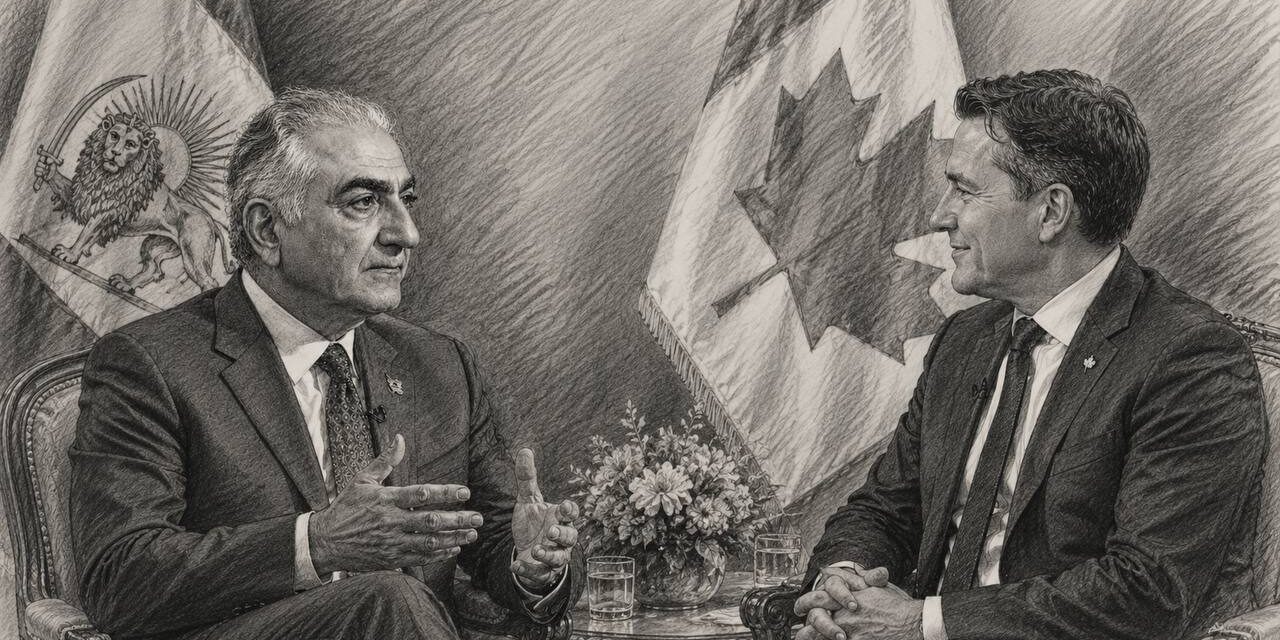
The Canadian Press article published by CityNews on August 20 contains facts worth reporting. Pierre Poilievre invited Crown Prince Reza Pahlavi to Canada. Mr. Pahlavi accepted. Canada has not formally endorsed any Iranian opposition leader.
The problem begins when the article moves beyond those facts.
Throughout the piece, subtle but repeated choices of language reduce a large and complicated Iranian political movement to the personal ambitions of one man, while serious accusations made by his opponents are presented with little examination. The result is not simply critical journalism. It is framing.
Consider the opening sentence:
“The former crown prince of Iran, who is pitching himself as the best option to lead Iran back to democracy…”
“Pitching himself” is not a neutral description of the political situation.
Reza Pahlavi has certainly declared his willingness to lead Iran through a transitional period. But that is only half of the story. During the 2025-26 uprising, demonstrators inside Iran repeatedly used pro-Pahlavi slogans and the Lion-and-Sun flag. Large demonstrations outside Iran have done the same. In February, an estimated 250,000 people attended the Munich demonstration called by Pahlavi, accompanied by large rallies elsewhere. Reporting his leadership claim while omitting the public constituency behind it changes the meaning of the story. (AP News)
The distinction matters.
There is a considerable difference between saying, “Pahlavi says he should rule Iran,” and saying, “Pahlavi has offered to lead a transitional process while substantial numbers of Iranians have publicly called on him to do so.”
More importantly, Pahlavi has not proposed that Iranians simply replace an ayatollah with himself as an unelected permanent ruler.
His stated transition model leads to a referendum in which Iranians choose their future system of government, followed by an elected constituent assembly, drafting of a new constitution, another referendum on that constitution, elections and, ultimately, transfer of authority to elected institutions. The Iran Prosperity Project has published an extensive framework for precisely this process. (IPP)
Yet only twelve lines into the article, readers encounter essentially the same framing again:
“Pahlavi … has argued he would be the best figure to replace the Ayatollah…”
Replace the Ayatollah?
That language collapses the distinction between transitional leadership and permanent rule.
It also quietly converts a political movement into an individual job application.
The eventual form of government proposed in Pahlavi’s transition framework is to be determined by the Iranian electorate, including a choice between a republic and parliamentary monarchy. That distinction is central to understanding what he is proposing. It should not disappear from a news report about his political role. (IPP)
A “crowd,” but no people
The article also describes Poilievre speaking to “a crowd” and says the announcement of Pahlavi’s invitation produced “loud applause.”
Technically, there is nothing false about the word “crowd.”
Journalistic bias rarely requires a false sentence. Selection and context can do the work.
The article gives readers almost no sense of the much larger political phenomenon surrounding Pahlavi, including demonstrations inside Iran, the Lion-and-Sun symbolism visible during the uprising, or the enormous rallies organized abroad. Even the CBC reported approximately 350,000 participants at the February Toronto rally responding to Pahlavi’s call for a global day of action (CBC); although organizers’ estimation has been over 500,000.
A journalist is free to question whether those demonstrations establish majority support. They do not constitute an election, and no responsible supporter should pretend they do.
But they are evidence.
Leaving that evidence outside the frame while repeatedly portraying Pahlavi’s leadership as something he has merely asserted for himself is a consequential omission.
The article presents an accusation of political emptiness while omitting the published transition plan
The piece tells readers that critics “charge that Pahlavi hasn’t managed to build a viable governance platform during his years in exile.”
That is a particularly strange statement to reproduce in August 2026 without immediately informing readers about the Iran Prosperity Project.
Whether one agrees with the plan or not, it exists.
It addresses the emergency period following the collapse of the Islamic Republic, legal continuity, state institutions, economic stabilization, security, energy, foreign affairs and the constitutional transition. It lays out stages leading from the transitional government to a referendum, constituent assembly, constitution and elected permanent government. (IPP)
A journalist could examine it and conclude that it is inadequate.
A journalist could interview constitutional scholars who oppose it.
A journalist could identify weaknesses, contradictions or impractical assumptions within it.
But telling readers that critics say there is no viable governance platform while failing to tell them that a detailed governance and transition project has actually been published does not give readers enough information to evaluate the accusation.
Then comes Kaveh Shahrooz
The article devotes some of its strongest language to a March commentary by Kaveh Shahrooz:
> “Despite his professed respect for Iran’s ethnic minorities, Mr. Pahlavi refuses to even discuss federalism or language rights.”
Two different subjects are bundled together here as though rejecting one entails rejecting the other.
It does not.
Federalism is a system of territorial government. Language rights are civil and cultural rights.
An Iranian political figure can oppose federalizing Iran while supporting the cultural and linguistic rights of Iranian citizens. There is no contradiction between those positions.
Pahlavi has, in fact, publicly discussed cultural and linguistic rights. He has spoken of Iranians’ right to preserve their languages and cultures while maintaining a common national language. His broader transition framework also grounds individual rights and legal equality in universal rights principles.
That makes the categorical statement that he “refuses to even discuss … language rights” something that should have been fact-checked rather than simply reproduced. (Reddit)
Federalism is a separate political argument.
Iranians can debate it. Pahlavi can oppose it. Kurdish parties can advocate it. Neither position becomes illegitimate simply because the other side dislikes it.
There is also historical context missing from the Canadian Press article. Modern Iranian anxiety about territorially based autonomy is inseparable from the experience of Soviet-occupied northern Iran in 1945-46, when Soviet support helped establish the Azerbaijan People’s Government and supported the political conditions surrounding the Republic of Mahabad. The Azerbaijan government was led by Ja’far Pishevari and had a Marxist-Leninist political structure. (Wikipedia)
That history does not prove that every contemporary Iranian federalist is a separatist or Marxist. It does explain why “federalism” carries historical and security associations in Iranian political discourse that a Canadian reader may not recognize.
Presenting Pahlavi’s opposition to federalism simply as evidence that he disregards minorities strips away that context.
“Ethnic minorities” is itself a political frame worth examining
There is another assumption buried in the article.
Iran is not easily described through a Canadian-style majority-versus-minority framework. Azeris, Kurds, Lurs, Baluch, Arabs, Persians, Mazanderanis, Gilaks and others have participated in Iranian political life across centuries, while many Iranians carry overlapping regional, linguistic and national identities.
This does not mean discrimination does not exist. It means that importing an oppressor-versus-oppressed ethnic template into Iranian politics without examining Iran’s own history can distort more than it explains.
A serious article should distinguish cultural rights, administrative decentralization, federalism, autonomy and separatism.
They are not synonyms.
The most serious accusation receives the least scrutiny
Shahrooz is then quoted saying:
“The illiberal, thuggish behaviour of the movement he has cultivated contradicts his polished speeches.”
That is an extraordinary accusation.
What exactly does “cultivated” mean?
Did Pahlavi order harassment?
Fund it?
Organize it?
Encourage it?
Refuse to condemn a documented incident?
What evidence establishes a command or organizational relationship between him and anonymous individuals behaving badly on social media?
The article provides none.
Instead, behaviour attributed to some supporters becomes “the movement he has cultivated,” and that characterization is placed prominently before the reader.
Political leaders can and should be questioned about the conduct of organized movements operating under their authority. But guilt by association is not a substitute for evidence.
There is another reason Canadian journalists should approach this subject carefully.
Only a few paragraphs later, this same article acknowledges that Canada’s foreign-interference inquiry found that the Islamic Republic conducts transnational repression and “psychological harassment online.” It also reports Iranian Canadians’ allegations that Tehran sends agents abroad to intimidate its opponents. (CityNews Toronto)
Those facts should produce journalistic curiosity.
In an online Iranian political environment known to be targeted by a hostile state, who operates the accounts involved in coordinated harassment? Are they genuine supporters, provocateurs, regime-linked networks, unaffiliated extremists, or some combination of these?
Without establishing that, assigning anonymous online conduct to a political leader is irresponsible.
That does not mean every abusive account is an Islamic Republic agent. There is no evidence for such a sweeping claim.
It means precisely the opposite: the evidence needs to be established before political responsibility is assigned.
Notice whose claims receive quotation marks
There is also a structural imbalance in the article.
Pahlavi’s critics receive powerful direct quotations:
“refuses to even discuss federalism or language rights.”
“threaten sending in an army.”
“illiberal, thuggish behaviour.”
His supporters’ argument is reduced largely to a single quotation from a parliamentary petition describing him as a democratic and nationally recognized transitional leader.
Where are the Iranians who actually support him?
Where are those who support a republic but nevertheless regard him as the appropriate transitional leader?
Where are constitutional monarchists?
Where are participants in the uprising?
Where are the political organizers who can explain why the Lion-and-Sun flag and Pahlavi slogans became visible during the protests?
The article is ostensibly about a Canadian political leader inviting Reza Pahlavi to Canada. Yet one of its longest substantive descriptions of Pahlavi’s politics comes from one of his critics.
That is an editorial choice.
Even the description of Mohammad Reza Shah is loaded
The article states:
“his critics say his father ran a western-backed dictatorship…”
The attribution “his critics say” technically protects the sentence from being presented as the reporter’s own conclusion.
But notice what information follows it: none.
There is no competing historical interpretation, no context concerning Iran’s constitutional system, no discussion of the Cold War, no distinction among the different phases of Mohammad Reza Shah’s 37-year reign and no indication that the political history of pre-1979 Iran remains deeply contested among Iranians and historians.
For an article about Reza Pahlavi in 2026, this becomes hereditary political indictment. The father’s government is introduced principally as evidence against the son.
Reza Pahlavi was not Iran’s head of government in 1978. He was a teenager.
His political proposals in 2026 should be examined on their own evidence.
What the article strangely fails to ask
The most interesting question raised by Poilievre’s invitation receives surprisingly little attention.
Why is the leader of Canada’s Official Opposition meeting Reza Pahlavi now?
Why has Pahlavi become sufficiently politically relevant that Canadian politicians are publicly engaging him?
Why have enormous numbers of Iranians repeatedly gathered under the Lion-and-Sun flag?
Why did a quarter of a million people reportedly attend the Munich, another half a million attend the Toronto, and thousands, if not hundreds of thousands, elsewhere in a global demonstration following his call?
Why have demonstrators inside one of the world’s most repressive states been willing to risk severe punishment – mass killings by snipers and machine guns – while chanting slogans associated with the Pahlavi name?
None of those facts proves how Iran would vote in a free election.
That is precisely why Pahlavi’s stated program calls for a vote.
Iranians themselves must determine whether their future is republican or monarchical. Canadians do not get that vote. Neither does Pierre Poilievre. Neither does the Canadian Press. The people of Iran do.
That principle should also change how Canadian journalism covers them.
Criticize Reza Pahlavi. Investigate him. Challenge his transition plan. Interview his opponents. Examine his supporters. Ask difficult questions.
But apply the same scrutiny to accusations made against him.
Do not turn evidence of a popular political movement into one man’s “pitch.” Do not confuse opposition to federalism with opposition to language rights. Do not attribute anonymous internet behaviour to a leader without establishing the connection. Do not tell Canadians that a governance plan is missing without informing them that a detailed transition project exists.
And above all, do not write millions of Iranians out of their own political story.
They are not a “crowd” surrounding Reza Pahlavi.
They are political actors with voices, demands and, eventually, votes of their own.
By: Soorena Noori, Co-founder of Iran Revival Hub